
But why do writers use codes and processes, instead of “coming right out and saying it?” If writers want us to grasp their message, how can they Not be hiding it when they don’t just say it!
Good Question.
The answer is found in the nature of fiction. Authors are not hiding from you. Quite frankly, there is no place for them to hide.
Literally, No Place.
Because no place exists in conventional fiction within the dynamic of text and reader that allows the author to speak directly to the reader.
Now those of you who follow the Ton may be thinking about Bridgerton, and its “my dear Reader”. She is speaking directly to the reader. But the voice over is writing journalism, gossip journalism, within the fictional story. It is her purpose to speak directly to the reader. Catch them up, give an overview of the current status of affairs. Notice, once the story begins, the voice over disappears. Spoiler Alert: Her voice actually becomes a character.
I am speaking directly to you now. But, I am writing non-fiction. I have a message that I am communicating to you. Writer to Reader. I am not building a world; I am establishing and developing an idea. You could expect a thesis statement from me. What is my point with this writing? What is my controlling idea?
That all changes if I had the added task of creating a believable world for you to enter, a world that also has meaning. Authors of fiction do have points they want to make about Life and people living it, but these authors do not have the ease of a thesis statement. That would ruin the whole effect of storytelling.
In Fiction, the world being created must speak for itself, must speak for the author.
The author’s role is to build the world, populate it with believable people and realistic settings, objects and phenomena that make you imagine, indeed believe, that this world of the author’s creation exist.
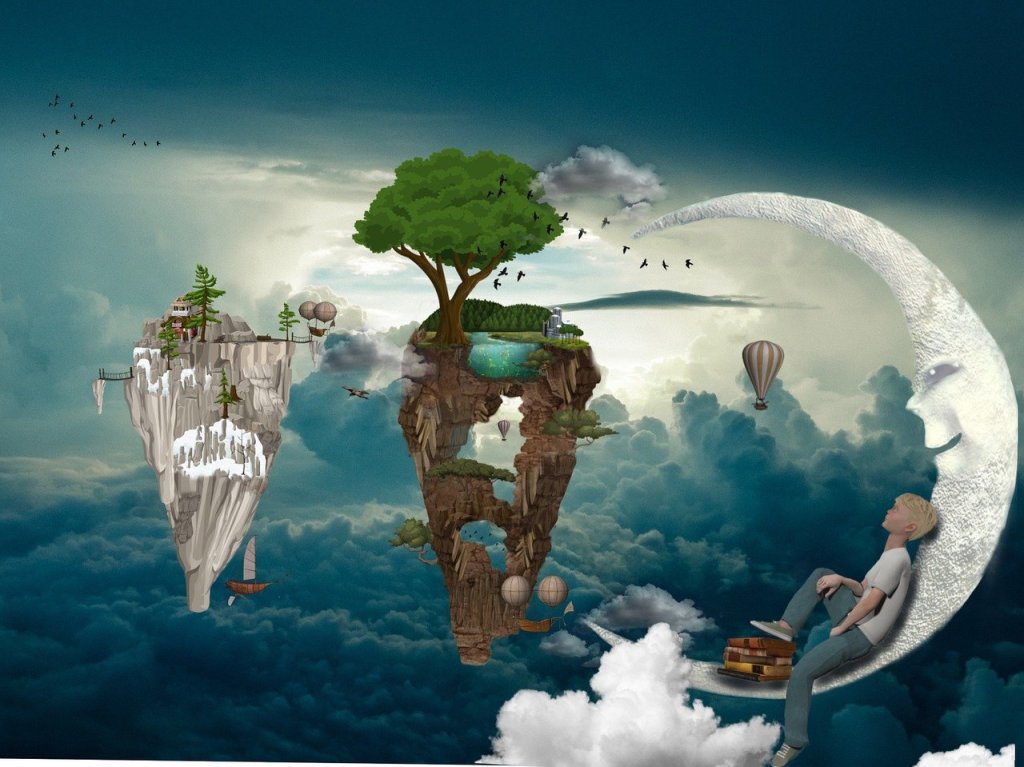
It is a wonderfully collaborative partnership between the author and her readers. Black marks on white pages enter the reader’s mind and become full scale movie sets. As a reader, our memories and experience are the tools we use to bring life to the author’s printed text. This dance of creation can only be sustained if the author continues to build that world, continues to provide us the descriptions and actions that fuel the enterprise. Should the author stop building the world, the screen goes dark.
If writers do not continue to describe the room, the people, what is being said, the actions, who thought what, there is no reality of the text.
No mechanism exists for the author to speak directly to the audience. The author can’t say: “Hey! Pay attention! I’m doing something here with this part that you’re going to need to grasp my meaning.”
How would that look on the page? Who would we think that voice was?
It’s not a character. It’s not a narrator, being our eyes and ears, world building.
Some voice would be directing how we think about what we were experiencing, pulling us out of that experience, and drawing attention to the fact that we are reading. It would literally be Other Worldly in our scenario. An Entity existing outside of the world created inside the pages.
Texts and their dynamic with readers, by their nature, leave the author mute regarding instruction for meaning. The only method at a writer’s disposal to grab your attention must be subtle, non-direct, or they would be interrupting their world creation.
Hence the clue system for building, and communicating meaning.
Authors are not cleverly trying to hide from you. Quite the contrary. Authors are creating meaning, and pointing to it right in front of your eyes.
Trust me. No one is trying to trick you. Let your guard down, and come as you are.
You are enough.
 The Comfortable Reader
Leave a comment